ELT & the Science of Happiness

This website is about ELT -- English Language Teaching. And about Positive Psychology -- something TIME magazine calls, "the Science of Happiness."
It is for EFL and ESL teachers who want to use activities that work on specific language points (grammar, functions, topics and vocabulary) while having students do things that positive psychologists find are connected to happiness and well-being.
Basically, positive psychology is the study of what is going on in the minds of happy people. Traditional psychology focusses on mental illness. Positive psychology focusses on mental health.
As teachers we all deal with educational psychology, either consciously or by default -- we do deal with psychology.
Why positive psychology in the ELT classroom?
It is for EFL and ESL teachers who want to use activities that work on specific language points (grammar, functions, topics and vocabulary) while having students do things that positive psychologists find are connected to happiness and well-being.
Basically, positive psychology is the study of what is going on in the minds of happy people. Traditional psychology focusses on mental illness. Positive psychology focusses on mental health.
As teachers we all deal with educational psychology, either consciously or by default -- we do deal with psychology.
Why positive psychology in the ELT classroom?

For starters, we know that happy students:
- learn more
- work longer at tasks
- approach those tasks with more enthusiasm. (source)
We also know that, as they are feeling good, the neuron connections -- learning centers -- are lighting up with serotonin, endorphins, and dopamine -- those "feel good" neurotransmitters that go along with learning.
The site will share activities (at last count over 50 classroom tasks, 15 posters, and lots of support articles and links) you can do with your students to increase happiness while they build their English.
Marc Helgesen
Miyagi Gakuin Women's University
Sendai, Japan
- learn more
- work longer at tasks
- approach those tasks with more enthusiasm. (source)
We also know that, as they are feeling good, the neuron connections -- learning centers -- are lighting up with serotonin, endorphins, and dopamine -- those "feel good" neurotransmitters that go along with learning.
The site will share activities (at last count over 50 classroom tasks, 15 posters, and lots of support articles and links) you can do with your students to increase happiness while they build their English.
Marc Helgesen
Miyagi Gakuin Women's University
Sendai, Japan
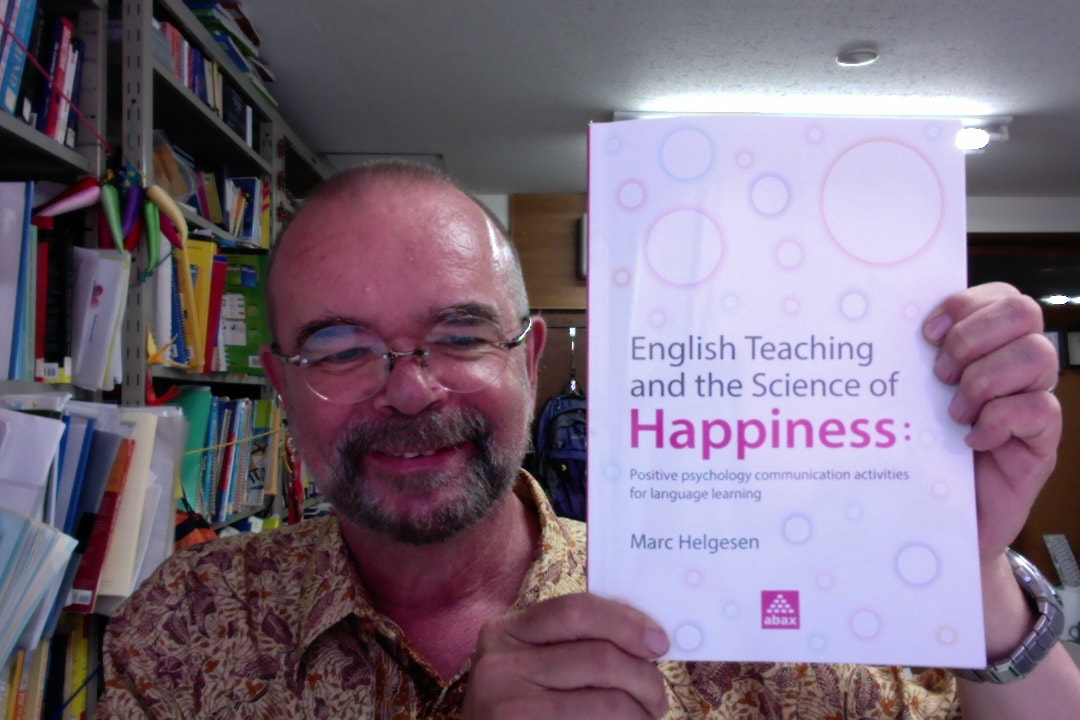
My new book, English Teaching and the Science of Happiness: Positive Psychology Communication Activities for Language Learning is now available from ABAX. Click HERE for a link to the ABAX website.
The book is 280 pages and has lots of photocopiable activities.
The book is 280 pages and has lots of photocopiable activities.